

A few months ago, I wrote here about the singer Myrtle Watkins, who performed at the Taj in Bombay during the winter of 1935. She had made her reputation as a jazz singer in Europe but then, in a transformation I couldn’t quite track in the archives, seems by the late 1930s to have started performing Latin American music under the name Paquita, along with her husband, the Mexican violinist Sam Zarate.
Between November 1941 and December 1942, Paquita and Zarate cut more than a dozen discs in India, backed by the African-American pianist Teddy Weatherford, like the one above, South American Way. The confusion about the performer’s identify arose when a discography published in the jazz magazine Storyville said that Paquita was actually the stage name for Myrtle Watkins. But I wasn’t able to find other evidence for this, and the photos I had of Paquita and Watkins (reproduced above) were too indistinct to be able to make a clear identification either way.
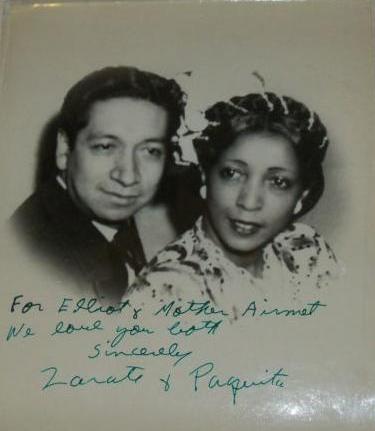
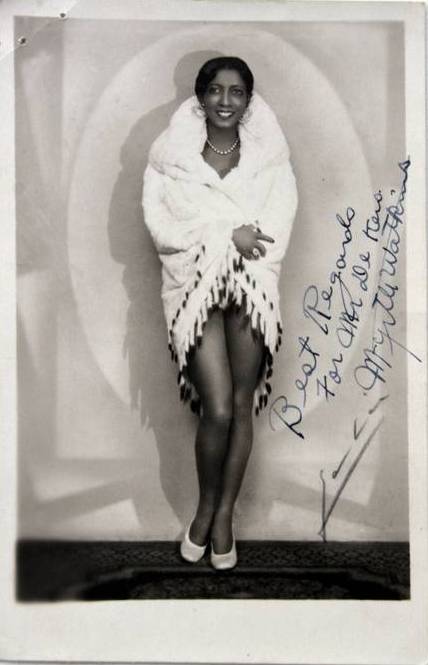
But recently, a generous reader – improbably, from Utah – sent me a photo of Paquita that matches perfectly with my grainy photo of Myrtle Watkins. “I have some wonderful photos and information that may help with the identification of Paquita & Zarate,” Angie Bourdos, who runs a gift shop in Salt Lake City said in a comment she left on the Foxtrot site. “I have posted and original signed photo from the 40s in Reno Nevada along with a collection of other original autographs, referring to Mother Airmet and Elliot Airmet from this duo.” Quite by coincidence, a few days later, a website that sells photos published a much clearer, autographed photo of Myrtle Watkins.
Angie found the photo in the collection of a man who ran a Greek restaurant called Cosmo’s in her hometown. She said that one of his friends would take risqué photographs of performers, which an artist named Jack “Dude” Larsen would paint in water colours to be hung in the restaurant. Larsen also touched up photos for other performers, singers and dancers and puppeteers. The Airmet family, to whom this photo of Paquita and Zarate is signed, had a group called the Airmet Marionettes.
“You should take a moment to look at the photos I have got,” she said. “They all go together in one big endless historical story! Salt Lake had more excitement back then compared to now! Ha.” Thanks, Angie, for proving conclusively that the African-American jazz singer named Myrtle Waktins did indeed later become a performer of Latin American standards in India. But now, we’re left with the puzzle of what exactly Paquita and Zarate were doing in Salt Lake City.
For what it’s worth, I’m also including a recording of South American Way by the Brazilian samba singer and Broadway star, Carmen Miranda, which has a much more pronounced samba beat. (Thanks to Heiko Mohn for the Paquita and Zarate recording.)

6 comments
I am completely blown away by this article which is possibly the answer to my puzzle. Samuel B. Zarate and Paquita moved to Depoe Bay, Oregon in 1959. Prior to that year, they had been living in Los Angeles, CA. Their agent booked them all over the west coast. One of their appearances was at Amato’s Supper Club in Portland, Oregon. From there, they performed at a Depoe Bay resort called “King Surf” in their Pagan Hut. After noticing property for sale just north of Depoe Bay, they purchased it and moved there in 1959. I lived in the Newport area and became Mr. Zarate’s piano accompanist in the early ’60’s and throughout his lifetime. They taught music to local students and also had an adjoining restaurant called “The Gingerbread House” where they served Mexican and Indian cuisine. Their local concerts included classical violin and viola in the first half and Songs from around the world in the second half when Paquita would join Sam on the drums and sing. It was our understanding that she was East Indian and he had been sent to Paris to continue violin studies by the Mexican government which is where they met. Paquita died in 1968. Sam continued with concerts dedicated to her until his death in 1993. I know more but am completely floored to learn that Paquita was Myrtle B. Watkins. I had been trying to solve the mystery of a wedding license issued to Samuel B. Zarate and Myrtle B. Watkins.
It would be lovely to view photograghs of Zarate and Paquita from the late `60s
This is just fabulous!
I was so happy to find this article as well and a proper home for the photograph. I just saw your replies today while showing my son a few photos of the Joseph Smith building Brigham Young University in Provo Utah that has Mr. Elliot Airmets name on the photographs. Some of the photos point up high with pride as to show how high the brick went up in a certain area of the building.
Maybe here in the winter I may find time to go through more of the photos , and recordings to see if there’s anything else that I can find. I think it’s fabulous being a Greek in Utah that Utah had such a wide variety of entertainers and seems as a fun food filled hub of the West with every race and religion. I absolutely just love it.
Thanks for the history behind Zarate and Paquita. I once stopped by the Oregon Coast chapel Sam built to honor Paquita and bought one of their Depoe Bay/Twenty Miracle Miles 45s. Must have been shortly before he passed away in the early 1990s. A very gracious man. The giant white bull outside the chapel along Highway 101 near Gleneden Beach was an iconic landmark. Had the opportunity to share the two tunes on the 45 on the Tom Morton Show on BBC Radio Scotland in about 1994.
Mr. Zarate was my music teacher for years when I was growing up during the 1960s, He and Paquita lived near near Gleneden Beach/Depoe Bay, Oregon.
What HE told me was that Paquita was from India. They met when they were both studying in Paris as young people.
Paquita was not specifically a singer, but a dancer. She was from India, while he was from Mexico. He played many instruments. I took piano and violin lessons from him. She taught dance there for awhile before I knew them.
He was raised Catholic, and she Hindu. I remember the caste symbol on her forehead. They were both well-educated and ultimately gracious people. She was articulate and dignified, and she teased him endlessly about “murdering the King’s English” because of his accent. Their respective families disowned them when they married because of the religious differences. They were both from ‘prominent’ families, and rules were strict at that time.
They had children (possibly as many as six??, but I am not clear on that memory…), and were in Europe when WWII broke out. They had to escape – exactly from where, I don’t know, but a mixed-race couple in that time and place must have been a target – and it seems that their children didn’t make it.
I was told that after they made it to the United States, at one point Mr. Zarate played at Carnegie Hall (I still have a copy of the album that was recorded), but because of his “color”, he was not allowed to enter the building through the front doors, but had to come in the back way,, through the alley. They both experienced a great deal of racism, and he told me that the ‘straw that broke the camel’s back’ and prompted their move to the West Coast was that while they were walking down the street in a large city, a person saw them (Paquita always wore a sari, so she was an easy target), and that person went out of (his? her?) way to walk across the street, ccme up to them, and spit in Paquita’s face.
Mr. Zarate played at Salishan Lodge, a local high-end resort near Lincoln City, Oregon, for many years. Paquita died when I was a young adult, and after that he performed a concert there every year that he dedicated to her.
My father was a carpenter, and after Paquita passed, Mr. Zarate asked him to build the pulpit for the Little Chapel. Every holiday, Mr. Zarate bought an oversized, elaborate card for her and hung them on the chapel walls. He always wrote a sweet message to her, assuring her of his abiding love. He carried her picture inside his violin case until the day he died.
He taught me that “anyone can learn to play the notes, but without emotion, music is merely mechanical, merely noise; only when you truly love the music does it become art, joyous and beautiful.”
Mr. Zarate was the finest, kindest man, and the greatest, most truly “gentle”-man I have ever known. He taught me so much about patience, perseverance, and peacefulness – no matter what the difficulties – that I could never have understood without his example.
I am now 71, living in Washington State, still loving music, and still grateful for his presence in my young life.
As a side note, I will say that I remember Ramona Martin from my childhood. Small world.